
Many contractors walk into their first federal bid assuming that a thin past performance file is a death sentence. It isn't. What does past performance record mean in contracting? At its core, it's the documented history of how well you've delivered on previous contracts, covering quality, cost control, schedule, and customer satisfaction. Federal agencies use this record to predict how you'll perform on future work. Understanding how that evaluation actually works, what gets counted, and how recent policy changes affect your standing, can shift your bidding strategy from reactive to genuinely competitive.
Table of Contents
- Key takeaways
- What does past performance record mean in contracting
- How agencies evaluate your past performance record
- Building and presenting your past performance volume
- The 2026 DoD policy shift and what it means for you
- My take on past performance after years in federal contracting
- How Vetadvantage helps you find your contracting edge
- FAQ
Key takeaways
| Point | Details |
|---|---|
| Official definition under FAR | Past performance covers workmanship, cost control, schedule adherence, and customer satisfaction on prior contracts. |
| Neutral rating for new entrants | Contractors with no relevant past performance receive a neutral rating, not a disqualifying one. |
| Commercial work counts | FAR authorizes federal, state, local government, and private contracts as valid past performance references. |
| CPARS is the tracking system | The government records evaluations in CPARS annually and at contract completion, with contractor comment rights. |
| 2026 DoD policy expands criteria | The 2026 NDAA requires DoD to accept broader commercial past performance and alternative capability proofs. |
What does past performance record mean in contracting
The Federal Acquisition Regulation defines past performance as a contractor's documented record covering workmanship, cost control, schedule adherence, cooperation with the agency, and customer satisfaction. That's not a vague impression. It's a structured assessment tied to specific contract numbers, delivery periods, and performance categories.
When a source selection official reviews your bid, they're asking one question: based on what you've done before, how likely are you to deliver what you're promising now? Past performance is the government's answer to that question. It's predictive, not punitive.
The meaning of past performance in contracts goes beyond a simple grade. It's a risk management tool. Agencies use it to reduce the chance of awarding work to a contractor who looks good on paper but struggles in execution. That's why a strong record isn't just a checkbox. It's a competitive asset that can tip a close decision in your favor.
How CPARS captures your record
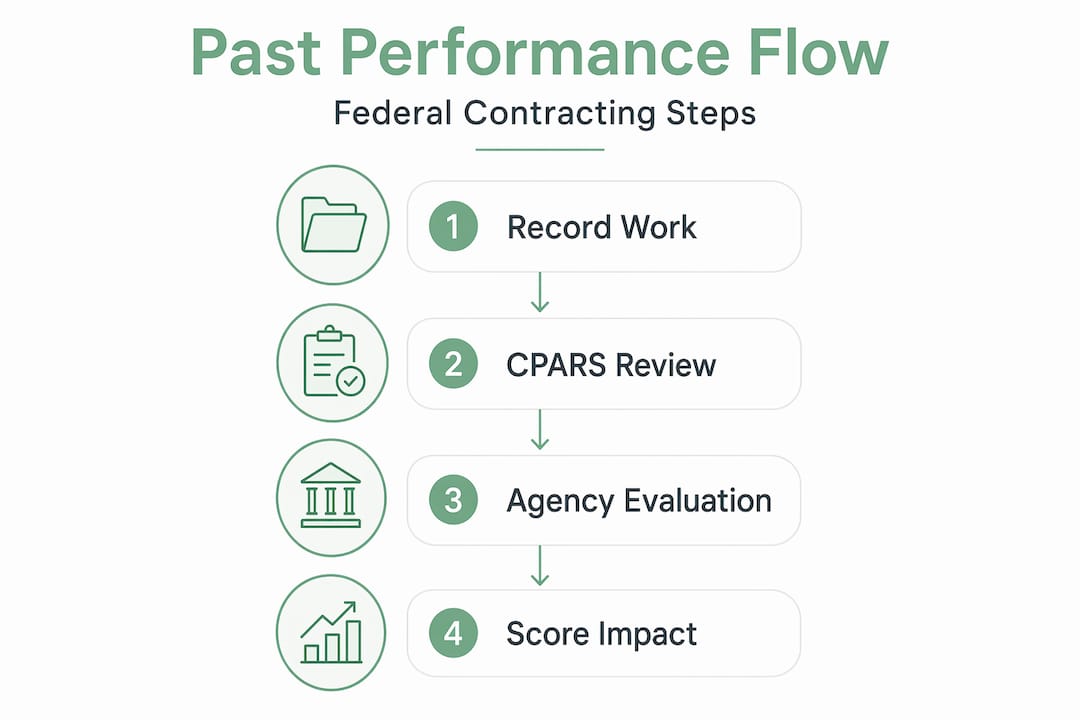
The Contractor Performance Assessment Reporting System, known as CPARS, is the official government platform for recording these evaluations. CPARS evaluations are completed at least annually and at contract completion, and they include both a standardized rating and a written narrative.
Here's what most contractors don't realize: you have a 14-day window to respond to a CPARS evaluation before it's finalized. That response becomes part of your permanent record. A well-crafted contractor comment can clarify context, correct factual errors, and demonstrate professionalism, all of which evaluators can see during source selection.
- Workmanship and technical quality: Did you meet the performance work statement requirements?
- Cost control: Did you stay within budget or manage modifications professionally?
- Schedule adherence: Were deliverables on time, or were delays contractor-caused?
- Cooperation and communication: Did your team work constructively with the contracting officer?
- Customer satisfaction: Did the agency feel the contract achieved its intended outcome?
Pro Tip: Never ignore a CPARS evaluation, even if you think it's unfair. A timely, factual response that addresses specific concerns without being defensive can actually strengthen how evaluators perceive your company's accountability and professionalism.
How agencies evaluate your past performance record
Understanding the contractor performance record definition is one thing. Knowing how agencies score it is another. FAR 15.305(a)(2) lays out three evaluation dimensions that every source selection official applies: relevance, currency, and quality.
Here's how each one works in practice:
- Relevance refers to how closely your prior work matches the scope, complexity, and dollar value of the current solicitation. A $200,000 janitorial contract doesn't demonstrate capability for a $4 million IT services award, even if both were performed flawlessly.
- Currency means recency. Work performed in the last three to five years typically carries the most weight. Older contracts may be considered but often receive reduced emphasis unless no recent work exists.
- Quality is the actual performance rating. This is where CPARS narratives, client references, and documented outcomes matter most.
What happens when you have no past performance
This is where the rules work in your favor. A lack of relevant past performance results in a neutral rating, not a failing one. Agencies are required to treat no record as neither an advantage nor a disadvantage. You're still in the competition.
The practical implication: a new contractor with a neutral past performance rating and a strong technical proposal can absolutely beat an incumbent with mediocre ratings. The neutral rating keeps you in the game. Your technical and price volumes win it.
| Scenario | Past performance impact | Competitive standing |
|---|---|---|
| Strong, relevant CPARS record | Positive risk assessment | High advantage |
| Neutral (no relevant record) | Neither positive nor negative | Competitive if tech proposal is strong |
| Mixed record with improving trend | Moderate positive signal | Evaluated case by case |
| Negative CPARS with no response | High risk flag | Significant disadvantage |
Past performance typically accounts for 20 to 30 percent of the total evaluation score in competitive acquisitions. Poor ratings can lead to rejection even when your price is the lowest. That's the significance of past performance records in plain terms: it's not just one factor among many. It's often the tiebreaker.

Building and presenting your past performance volume
Knowing how to assess past performance from the evaluator's perspective lets you present your record more strategically. The goal isn't to list every contract you've ever performed. It's to select and document the contracts that most closely mirror the work you're bidding on.
Selecting the most relevant contracts and documenting them with quantifiable results is what separates a strong past performance volume from a generic one. Each entry should include the contract number, agency or client name, period of performance, contract value, your role (prime or subcontractor), and a concise description of scope.
- Quantify everything you can. "Delivered 98.7% on-time performance across 240 monthly deliverables" is far stronger than "maintained excellent schedule performance."
- Match scope to solicitation. Read the performance work statement carefully and select contracts where your prior scope overlaps with the current requirement.
- Include commercial and subcontract work. FAR authorizes federal, state, local government, and private contracts as valid references. Don't leave commercial experience off the table.
- Provide points of contact who will respond. A reference who doesn't return calls can hurt you as much as a bad rating.
- Address any negative history proactively. If you have a weak CPARS rating on a contract, include context in your narrative. Evaluators respect transparency.
Pro Tip: CPARS evaluations include contract numbers and prime/subcontractor role identifiers. When you list a contract in your past performance volume, make sure the details match exactly what's in CPARS. Discrepancies raise flags during verification and can undermine an otherwise strong submission.
The 2026 DoD policy shift and what it means for you
The most significant recent development in understanding past performance metrics is the 2026 National Defense Authorization Act. Section 824 of the NDAA directly addresses how the Department of Defense evaluates past performance, and the changes favor smaller and nontraditional contractors in meaningful ways.
"The 2026 NDAA requires DoD to accept a broader range of past performance including commercial work and to validate it effectively, aiming to increase competition and reduce barriers for small and nontraditional contractors." — FedBiz Access
Previously, DoD evaluators often gave limited weight to commercial past performance because it was harder to verify and didn't follow CPARS standards. The new mandate changes that. Commercial success can now be validated and counted as relevant past performance in DoD source selections, provided it demonstrates similar scope and capability.
The policy also encourages alternative evaluation methods like product demonstrations and technical testing for innovative firms. If your company builds technology solutions and has limited federal contract history, a well-structured demo may now carry real evaluation weight at DoD.
| Contractor type | Before 2026 NDAA | After 2026 NDAA |
|---|---|---|
| Small business, commercial focus | Commercial work often discounted | Commercial work actively validated |
| Nontraditional defense contractor | High barrier, limited CPARS history | Alternative proofs of capability accepted |
| New entrant, no federal history | Neutral rating, limited options | Demos and testing now recognized |
| Established prime with CPARS | Strong advantage | Advantage maintained, more competition |
The practical implication for your bidding strategy today: if you've been avoiding DoD solicitations because your past performance is primarily commercial, that calculus has changed. Build a commercial past performance package with the same rigor you'd apply to a CPARS-based volume. Document scope, outcomes, and client contacts. The door is open.
My take on past performance after years in federal contracting
I've watched contractors disqualify themselves before the competition even starts. They see a past performance requirement, assume their record isn't strong enough, and don't bid. That's the most expensive mistake in federal contracting.
In my experience, the contractors who win consistently aren't always the ones with the longest CPARS history. They're the ones who understand that evaluators prioritize the most relevant and recent work, not simply the most work. A single, well-documented contract that closely mirrors the solicitation scope will outperform a dozen loosely related ones every time.
What I've learned about CPARS is that most contractors treat it as a passive process. They get an evaluation, maybe glance at it, and move on. That's a missed opportunity. Your 14-day response window is a strategic tool. Use it to correct inaccuracies, add context to performance challenges, and demonstrate that your leadership takes accountability seriously. Evaluators read those responses.
The 2026 DoD changes genuinely excite me for smaller firms and veteran-owned businesses. For years, the past performance system inadvertently favored large primes with deep federal histories. The new rules don't eliminate that advantage, but they create real openings. If you have strong commercial work and can document it properly, you're no longer starting from zero in DoD competitions.
— Tony
How Vetadvantage helps you find your contracting edge
If you're a veteran contractor working to strengthen your federal bid strategy, Vetadvantage was built with you in mind. The platform goes beyond basic benefits guidance to help veteran-owned businesses and contractors identify advantages they may not know they're entitled to.

The hidden benefits finder surfaces lesser-known contracting and veteran-specific advantages that can directly support your competitive positioning. Many veteran contractors leave significant value on the table simply because they don't know what they qualify for. The benefits finder tool at Vetadvantage matches your profile to over 400 verified benefits with a short questionnaire, no sensitive personal data required. Whether you're preparing your first federal proposal or refining a bid strategy for DoD work under the new 2026 rules, Vetadvantage gives you a clear starting point for understanding what resources are available to you.
FAQ
What does past performance mean in federal contracting?
Past performance in federal contracting is the documented record of a contractor's delivery on previous contracts, covering quality, cost control, schedule adherence, and customer satisfaction. Agencies use this record to assess risk and predict future performance during source selection.
What happens if I have no past performance record?
Contractors with no relevant past performance receive a neutral rating under FAR 15.305(a)(2), meaning they are neither penalized nor advantaged. A strong technical proposal can still win the award.
How is past performance evaluated in government contracts?
Evaluators assess three factors: relevance (how closely prior work matches the solicitation), currency (how recent the work is), and quality (the actual performance ratings and outcomes). Past performance typically accounts for 20 to 30 percent of the total evaluation score.
Can commercial contracts count as past performance?
Yes. FAR authorizes federal, state, local government, and private commercial contracts as valid past performance references, provided the scope and complexity are similar to the current solicitation requirement.
What changed about past performance under the 2026 NDAA?
Section 824 of the 2026 NDAA requires DoD to broaden its past performance criteria to include commercial work and alternative evaluation methods like demos and testing, specifically to reduce barriers for small and nontraditional contractors.