Federal contracting sounds like a maze until you understand the map. This VOSB set-aside contract guide breaks down exactly what veteran entrepreneurs need to know: how to get certified, how the VA's Veterans First program works, and how to compete for contracts that are literally set aside for businesses like yours. The federal government spends billions through these programs every year, yet many veterans miss out because of certification gaps, timing errors, or simply not knowing the rules. That ends here.
Table of Contents
- Key takeaways
- VOSB set-aside contract guide: eligibility and certification
- How the VA Veterans First program structures set-asides
- How to find and win VOSB set-aside contracts
- Sole-source rules and non-VA SDVOSB contracts
- Staying compliant after you win
- My honest take on VOSB contracting strategy
- How VetAdvantage helps veterans access set-aside opportunities
- FAQ
Key takeaways
| Point | Details |
|---|---|
| VetCert is non-negotiable | SBA certification is mandatory for VA set-aside contracts; self-certification is not accepted. |
| SDVOSB tier comes first | The VA considers SDVOSB set-asides before VOSB set-asides, affecting your bidding window. |
| VIP verification is a gate | You must be listed and verified in the VIP database at both offer submission and contract award. |
| Sole-source caps vary | Non-VA SDVOSB sole-source contracts cap at $4M for most industries and $7M for manufacturing. |
| Backlog is cleared | SBA reduced VetCert processing to an average of 12 days in 2025, so now is the time to apply. |
VOSB set-aside contract guide: eligibility and certification
Before you can compete, you need to qualify. The foundation is ownership and control. 51% veteran ownership is the baseline for a VOSB. For an SDVOSB, that 51% must come from one or more service-disabled veterans who also manage day-to-day operations. Ownership on paper is not enough. The veteran must hold genuine decision-making authority.
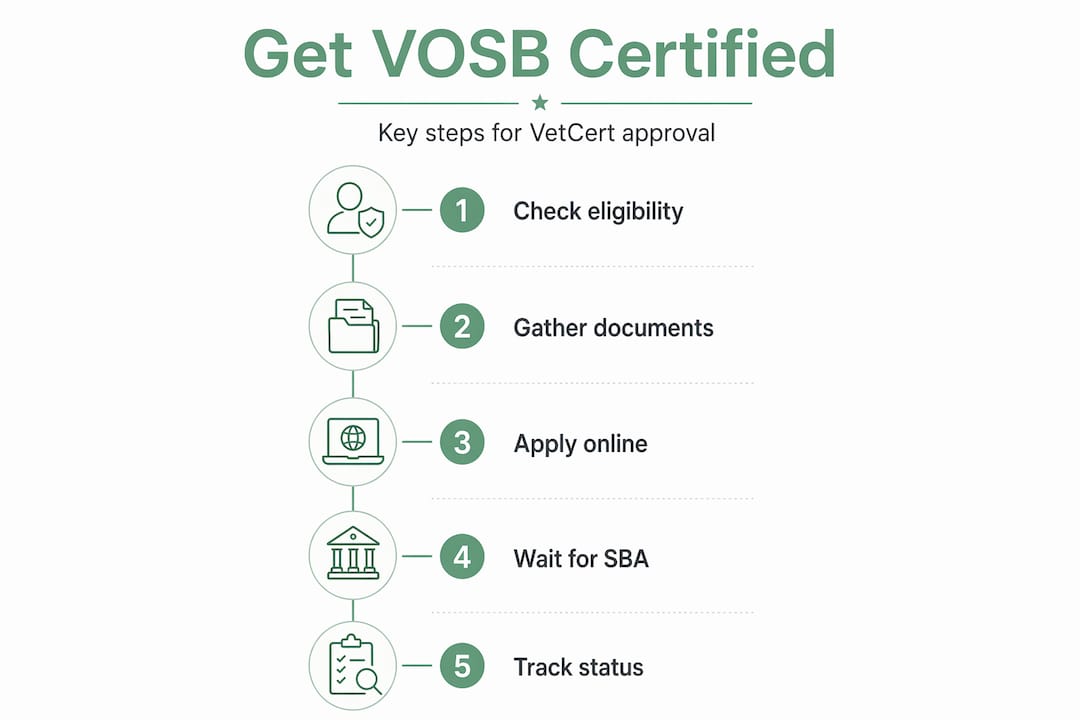
Here is where many veterans stumble: assuming that meeting those ownership criteria is all it takes. It is not. SBA VetCert certification is mandatory for any VOSB or SDVOSB looking to compete for VA sole-source and set-aside contracts. There is no self-certification option. If your application is not processed and approved, you cannot bid, period.
The key documents you will need to prepare include:
- DD-214 or other veteran status documentation
- Proof of service-connected disability rating (SDVOSB applicants)
- Business formation documents showing ownership percentages
- Operating agreements or bylaws demonstrating management control
- Personal financial statements for all owners above 10%
One piece of good news that changes the math on timing: the SBA cleared its VetCert backlog in November 2025, cutting average processing times to just 12 days. That used to be a months-long wait that cost veterans real contract opportunities. Now there is no excuse to delay.
Pro Tip: Start your VetCert application before you identify a specific contract to bid on. Waiting until you find an opportunity guarantees you will miss the submission window. Use the VSOPortal on VetAdvantage to organize your documentation before you apply.
| Criteria | VOSB | SDVOSB |
|---|---|---|
| Ownership requirement | 51% veteran-owned | 51% service-disabled veteran-owned |
| Management requirement | Veteran controls operations | Service-disabled veteran controls operations |
| SBA VetCert required | Yes | Yes |
| Eligible for VA sole-source | Yes (after SDVOSB tier) | Yes (priority tier) |
How the VA Veterans First program structures set-asides
The VA does not treat VOSB and SDVOSB set-asides as equals. There is a deliberate ordering built into the law, and understanding it will save you wasted bids and missed windows.
Under VAAR 819.7006(a), VA contracting officers must consider SDVOSB set-asides first for any procurement above the micro-purchase threshold. Only after determining that an SDVOSB set-aside will not work do they move down the priority ladder to VOSB set-asides. For veteran entrepreneurs who are not service-disabled, this means your window opens second, not first.
The process contracting officers follow typically looks like this:
- Conduct market research to identify SDVOSB vendors capable of performing the work.
- Apply the Rule of Two: determine whether two or more VIP-verified SDVOSB offers at fair price are reasonably expected.
- If yes, set aside for SDVOSB and issue the solicitation.
- If no, move to VOSB set-aside and repeat the Rule of Two analysis for that pool.
- If neither set-aside is viable, proceed to other small business or full-and-open competition.
This structure matters strategically. If you hold both VOSB and SDVOSB certifications, you compete at the first tier. If you are VOSB only, watch for solicitations that have already gone through the SDVOSB analysis, because those are your clearest opportunities.
"VA Veterans First's ordering effect means strategy and timing of bids are critical. The SDVOSB tier takes priority, directly affecting when VOSB bidders can compete." VA Small Business Programs
How to find and win VOSB set-aside contracts
Certification alone does not win contracts. You need a process for identifying opportunities, preparing bids, and avoiding the mistakes that sink otherwise strong proposals. Here is how to build that process step by step.
-
Register in SAM.gov and get your UEI. Your Unique Entity Identifier is required before any federal agency can pay you. Without an active SAM.gov registration, your bid is dead on arrival regardless of your VetCert status.
-
Confirm your VIP listing is current. The VIP database requires verification at both the time of bid submission and the time of contract award. A lapse between those two points can disqualify you even if everything else is perfect. Check your VIP status regularly, not just once.
-
Use beta.SAM.gov and GSA eBuy to find opportunities. Filter by NAICS code and set-aside type. Look specifically for solicitations coded as "SDVOSB" or "VOSB" set-asides. The procurement forecast tool on SBA.gov also shows planned contracts before they are formally solicited, giving you lead time to prepare.
-
Read the full solicitation before you write a single word. Many veterans lose bids by missing a mandatory clause or failing to acknowledge an amendment. Contracting officers are required to follow the rules exactly, and they will reject non-compliant offers without a second look.
-
Affirm your small business and veteran status in your offer. Your bid must include your VetCert certification number and confirm your VIP verification. Do not assume the contracting officer will look it up. State it directly in your offer documentation.
-
Price to win, not just to cover costs. The Rule of Two requires fair and reasonable pricing. If your price is the lowest compliant bid but still above the government's estimate by a wide margin, you lose. Study the Independent Government Cost Estimate range when it is publicly available, and build your price accordingly.
Pro Tip: Build a bid calendar. Most set-aside solicitations have submission windows of 15 to 30 days. If you are scrambling to assemble documents at the last minute, you will miss details that cost you the award. Use the claim readiness tools at VetAdvantage to keep your eligibility documents organized and current.
Sole-source rules and non-VA SDVOSB contracts

Set-aside contracts are not the only path. Sole-source contracts allow agencies to award directly to a single SDVOSB without competitive bidding, under specific conditions. Knowing these rules unlocks a faster lane for certain procurements.
For non-VA SDVOSB sole-source awards, 13 CFR 128.405 sets clear caps on anticipated contract value. The limits break down as follows:
| Contract type | NAICS category | Sole-source price cap |
|---|---|---|
| Non-VA SDVOSB sole-source | Manufacturing | $7,000,000 |
| Non-VA SDVOSB sole-source | All other codes | $4,000,000 |
| VA SDVOSB sole-source | All codes | Separate VA thresholds apply |
Beyond hitting the price cap, the contracting officer must also determine that the award is in the government's interest, that no more than one SDVOSB is capable of performing the work, and that the price is fair and reasonable. That last point is where many sole-source attempts stall. Document your pricing methodology thoroughly. Compare your rates to GSA schedule pricing, published wage determinations, or market survey data, and include that justification in your proposal.
For veteran entrepreneurs targeting non-VA agencies, sole-source thresholds differ from VA thresholds, and strategies for each must be built separately. The sole-source rules for non-VA contracts require tailored pricing documentation that aligns with the specific regulatory caps. Treat each agency as its own market with its own expectations.
Staying compliant after you win
Winning the contract is step one. Keeping it, and staying eligible for the next one, requires ongoing attention to compliance.
The most common post-award mistakes veteran contractors make:
- Letting VIP verification lapse. Your VIP status must stay current for the life of the contract. If you allow it to expire mid-performance, you create a compliance issue that could affect future awards or prompt a contract review.
- Ignoring subcontracting limits. SDVOSB and VOSB set-aside contracts include clauses that restrict how much work you can pass to non-eligible subcontractors. Violating those limits is a fast route to debarment.
- Missing recertification windows. VetCert is not a lifetime certification. Watch for renewal deadlines and start the recertification process early. Given that processing now averages 12 days, there is no reason to let your certification lapse between contract cycles.
- Failing to report on small business subcontracting plans. If your contract includes a subcontracting plan, you are required to submit periodic reports. Missing those reports is a contract compliance failure even if your actual performance is excellent.
- Not maintaining updated representations in SAM.gov. Your annual SAM.gov renewal must reflect your current business status, size, and certifications. Outdated representations can trigger eligibility challenges from competitors or the contracting officer.
Treat compliance as a continuous process, not a checklist you complete once. Schedule quarterly reviews of your VIP status, SAM.gov registration, and VetCert expiration dates. Use those reviews to catch problems before they become disqualifying.
My honest take on VOSB contracting strategy
I have worked with enough veteran entrepreneurs to know where the real friction lives. It is almost never about desire or work ethic. It is about timing and documentation, two things that feel administrative but actually determine whether you win or lose.
In my experience, the veterans who struggle the most with VOSB contracting are the ones who treat VetCert as something to handle "when the time comes." That mindset costs them months of eligibility. The certification should be your first move, before you have identified a single contract to bid on. Get certified, get verified, then go hunting.
What I find underestimated in most guides is how much the VIP verification timing can quietly sink a bid. I have seen veterans with valid VetCert certifications lose awards because their VIP listing lapsed between submission and award. The contracting officer's hands are tied. Eligibility is checked at both points. If you are not current at award time, the contract goes elsewhere. That is a painful and entirely preventable loss.
My other observation is about market research. Most veteran entrepreneurs do not start researching agencies and NAICS codes until they are already chasing a live solicitation. The veterans who consistently win start months earlier. They know which contracting officers handle their commodity, they have introduced themselves through capability statements, and they are on the radar before the solicitation drops. That is not insider advantage. That is preparation.
The path to winning VOSB contracts is genuinely accessible. The rules are public. The certifications are free. The backlog that used to block progress is cleared. What separates the veterans who win from those who do not is execution discipline.
— Tony
How VetAdvantage helps veterans access set-aside opportunities
Getting certified and staying compliant takes more organization than most people expect. VetAdvantage was built by a Navy veteran who knows exactly how costly administrative gaps can be, and the platform is designed to cut through that complexity.
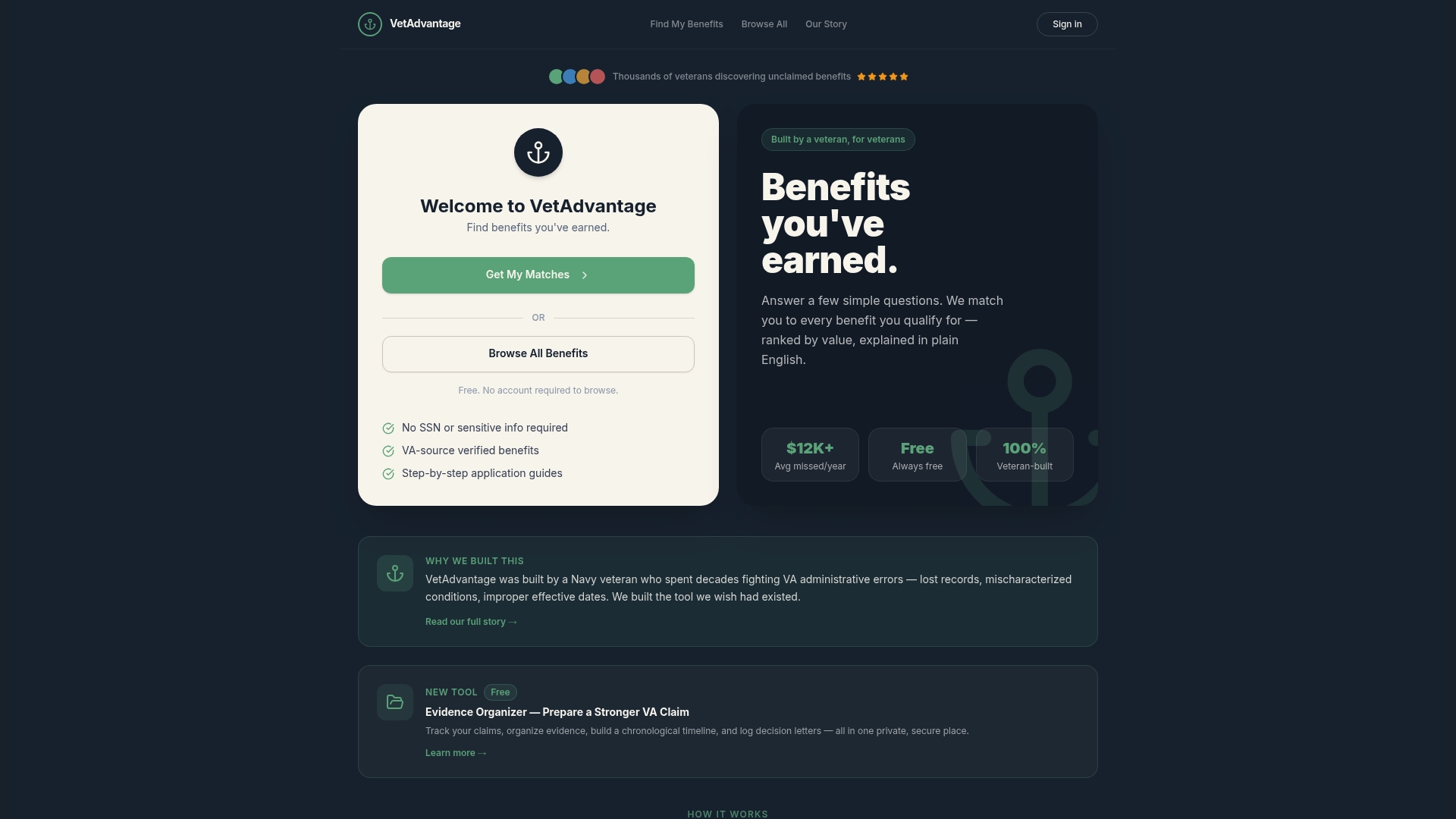
Through VetAdvantage, you can access tools that map your eligibility for over 400 verified benefits, track your documentation readiness for VetCert applications, and stay on top of the compliance requirements that keep you eligible between contracts. The hidden benefits finder surfaces programs many veteran entrepreneurs never knew existed, including grants and contract support resources that directly complement your VOSB strategy. The VSOPortal puts your certification management and verification tracking in one place. Veterans using the platform find an average of over $12,000 in missed benefits per year. Start your profile today and see what you have been leaving on the table.
FAQ
What is a VOSB set-aside contract?
A VOSB set-aside contract is a federal procurement reserved exclusively for verified Veteran-Owned Small Businesses, meaning non-veteran businesses cannot compete for the award. The VA prioritizes these contracts under its Veterans First program.
Do I need SBA VetCert to compete for VOSB set-asides?
Yes. SBA VetCert certification is required for all VA VOSB and SDVOSB set-aside and sole-source contracts. Self-certification is not accepted under any circumstance.
What is the difference between VOSB and SDVOSB set-asides?
SDVOSB set-asides require 51% ownership and control by a service-disabled veteran, while VOSB set-asides require 51% ownership by any veteran. Under the VA's Veterans First program, SDVOSB set-asides are considered before VOSB set-asides on every procurement.
How long does VetCert certification take?
As of November 2025, the SBA processes VetCert applications in an average of 12 days after clearing its backlog. Applicants should still apply well before any target bid date to avoid timing issues.
What are the sole-source contract limits for SDVOSBs?
For non-VA agencies, sole-source SDVOSB contracts are capped at $7 million for manufacturing NAICS codes and $4 million for all other codes. VA sole-source contracts have separate thresholds governed by VAAR regulations.